
This is a guest post by Noah Charney
My time in quarantine has been spent largely doing two linked things: engaging with and teaching my young daughters (aged 5 and 7) and writing my first parenting book, which explains my approach to inspiring a love of learning in my kids. I’m an established author (having written more than a dozen books, including best-sellers and a Pulitzer finalist), but all on the subject of art. Parenting is a new topic for me and I wanted to get a book out as quickly as possible, so that other parents might benefit from its content, which is ideal for helping parents proactively engage with their kids, during isolation and beyond. So I opted for a limited edition book called Superpower Your Kids: A Professor’s Guide to Teaching Your Children Everything in Just 15 Minutes a Day, launched via a Kickstarter campaign that runs June 4-July 4. You can check it out here.
The approach focuses on taking teaching techniques that I use in class with university students and applying a version of it to teaching my own kids. A key is asking children to learn very little at a time, always in the form of short games, but to do this regularly. I teach my girls a single thing a day, sometimes in as little as a minute, never more than 15 minutes at a time. There are a lot of ways to teach, but one of the best and easiest is to dip into books, especially illustrated encyclopedia or compendia. These are naturally subdivided into “bite-sized” entries, each of which takes just a few minutes to read with your kids. It is important to be fully present and focused for those few minutes of interaction: no TV in the background, no checking your phone. When I teach at University of Ljubljana, I use a preview-engage-review approach, and it’s the same at home. I talk about what we are going to learn, to whet the appetite. While reading I stop frequently to ask questions, clarify, be sure they understand. And when we’re done, for the rest of the day and that week, I’ll circle back to ask questions about what we learned or repeat the information, so it naturally, organically, is committed to memory.
You can do this with any books you happen to have at home or take out of the library. You can use online sources, but this doesn’t have the same feeling of tangible engagement—the screen in some way “separates” you from your kids in a way that the printed page does not. So opt for real books when you can. What follows is my subjective list of ideal keystone books that I have found incredibly useful and well worth owning. My kids and I go back to them often and for many lessons. If you’re open to adding to your library, these are some strong choices that will, single-handedly, provide for hundreds of miniature lessons, which I call “lessonlets.” Most are compendia, or visual encyclopedias. Each one offers ready-made lessons on every page.
DK Smithsonian Picturepedia: An Encyclopedia on Every Page (DK)
Each double-page spread of this wonderful picture book is packed with photographs grouped by theme: gems, occupations, foods, mammals, tools and so on. There are didactic illustrations but what is most fun for kids is just browsing. Open any double page spread and just talk through what you see there, and you’ve fulfilled your lessonlet for the day. The visual nature makes it easier for kids to memorize. I like to let my kids point to which paragraph of didactic material they want me to read in which order, to give them the power to choose.
Visual Dictionary (DK)
DK is great when it comes to picture-first compendia, and this series is particularly satisfying. The standard version is an encyclopedia of pictures of objects and words but with the twist that each word is presented by a picture and the word translated into five languages: English, German, Spanish, French and Italian. Teaching your young kids a second language is a powerful and practical way to play the Lesson Game, and this is a great way to start. Or, if you have bilingual children, like I do, then this also suits as we use it to develop a third language (German), or to play The Translation Game, in which we try to stump each other by asking for translations of words between our two household languages, Slovenian and English. If you have bilingual kids, then you may find specialized versions of this book featuring English, German, French, Italian plus your local language (our edition has the fifth language as Slovenian).
The Way Things Work by David Macaulay (HMH Books)
This is a classic (and there’s a recently updated and expanded edition), with beautiful cutaway drawings that serve to illustrate how mechanical and building projects function. It’s ideal for enthusiastic young engineers.
Any Illustrated Encyclopedias: of Animals, of Dinosaurs and Beyond
There are so many to choose from. Those by National Geographic and DK Smithsonian are excellent. The key is having plenty of good pictures and concise didactic material. This is more about browsing, less about reading.
Encyclopedia of Things That Never Were by Robert Ingpen and Michael Page (Viking)
It’s great to have a heavily illustrated book of fairytales to hand. Those by the Brothers Grimm (Hansel and Gretel, Rumpelstiltskin, Rapunzel, The Frog Prince), Hans Christian Andersen (The Little Mermaid, The Princess and the Pea, The Emperor’s New Clothes, The Ugly Duckling, The Snow Queen—which inspired Frozen) and by Charles Perrault (Sleeping Beauty, Little Red Riding Hood, Cinderella, Puss in Boots, Mother Goose) are the big three, the originators of so many of the classics (and so many Disney movies). The less text and more illustrations per page, the more absorbing it will be for younger children. So while I recommend illustrated compendia of such stories (reading each fairytale offers a ready-made lessonlet), Encyclopedia of Things That Never Were is a gorgeously-illustrated collection of mythological and fairytale creatures and characters, with their stories and origins summarized in brief. I used to adore browsing this book. It’s out of print now, but if you can find a used copy, it’s well worth it.
Any Illustrated Collection of Myths and Biblical Stories
Myths and Bible stories are the foundation tales of culture. Developing an understanding of them, recognizing references to them, can go a long way toward helping students interpret culture later on. I probably shouldn’t be admitting this, but when I was a student, I was able to proactively participate in loads of class discussions about books I had not actually read, because I was versed in the core tales that are so frequently referred to in literature, art, theater, film—all culture that came after. There is a set pool of stories from which so much later culture draws: the Bible, Greek and Roman mythology, fables and fairytales…then, if we’re getting into the Renaissance, we can add Greek philosophy and drama, Ovid’s poetry, Dante, and Jacobus da Voragine’s biographies of saints, but those you needn’t worry about when you’re talking to a five-year-old. The point is that early exposure to these stories is not only fun and interesting for kids but will later be useful. One’s religion and level of faith are not necessarily relevant to introducing these stories for what they are: keystone tales upon which so much later culture was built. If your family is religious, then you can present them in that context. If not, then you can present them simply as stories for now. The more illustrations (ideally one per page), the better for younger children.
These choices are very personal (and all in English), and they are meant merely as inspiration for you to pick your own, in whatever language suits. The key takeaway is to spend focused time each day, even if it’s just a few minutes, with you, your kids and a good, illustrated book.
Noah Charney’s latest project is a limited-edition book, available only in June on Kickstarter, called “Superpower Your Kids: A Professor’s Guide to Teaching Your Children Everything in Just 15 Minutes a Day.”
Books are certainly one of the easiest and best ways to learn.
In fact, I have been reading plenty of books during this lockdown, that I have been making is list of them.
I believe it is important to learn in bitesize chunks as there is only so much information we can take in at any one time.
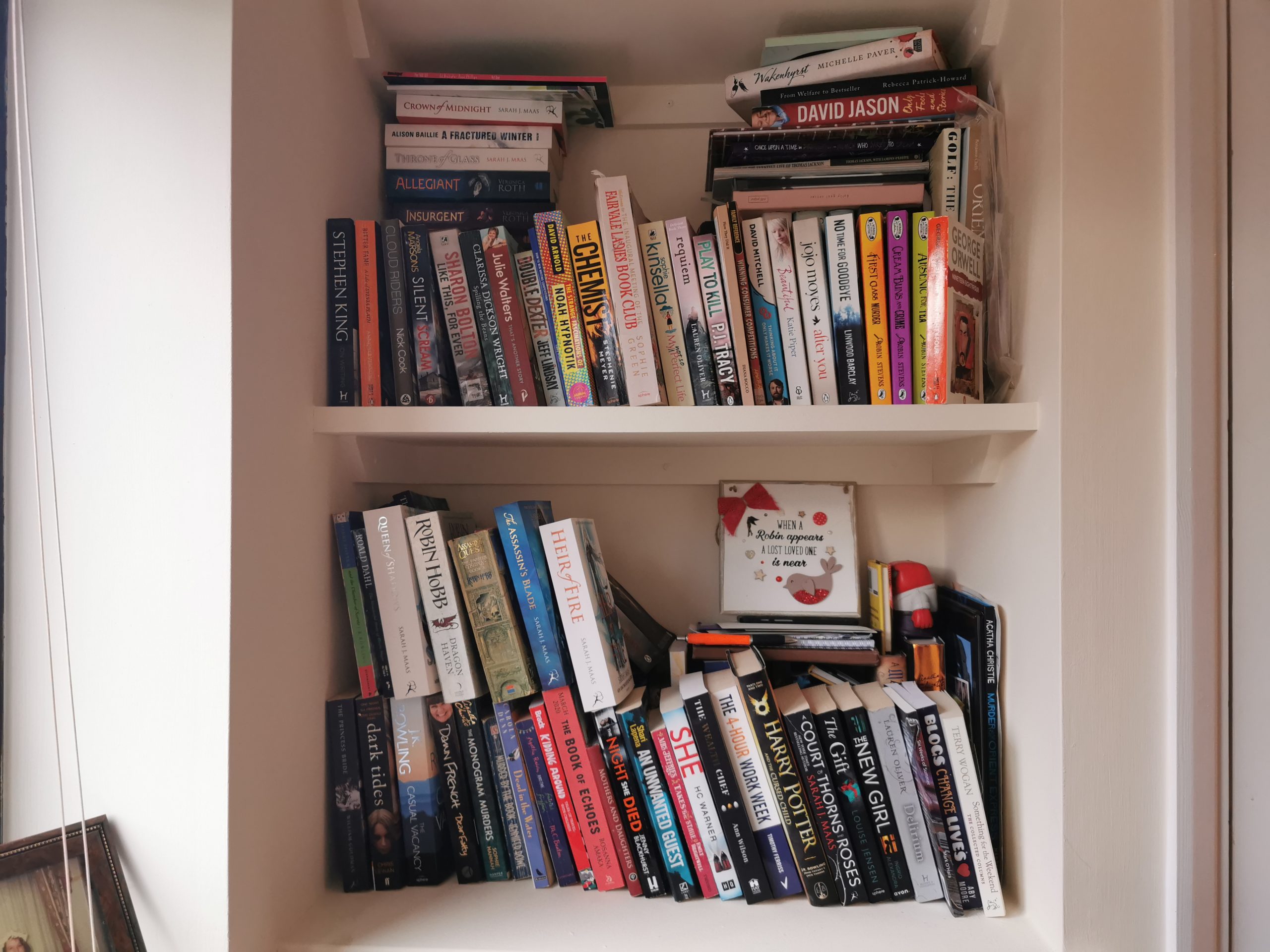
I noticed that you had, including the 4-Hour Work Week, which I actually read myself recently and it is really good.
Could you tell me the title of that George Orwell book on your shelf, as I am a big fan of his work?
These are some good foundations of having a home library whether you’ve got kids or not. Having these as a foundation would be super helpful x